The Hidden Cost of Building on Assumptions

Game development is expensive. But assumptions are even costlier. Learn why market validation errors derail promising projects and how studios can avoid wrong decisions using real market intelligence.

Harish Alagappa

The most expensive mistakes in game development aren’t bad features, they’re bad assumptions.
Every game starts with a gut feeling. A mechanic that “should work.” A genre that “seems hot.” A direction that “feels right.”
But the moment a studio commits to an idea without validating it, the budget quietly starts burning. And the tough truth is most failed game ideas don’t collapse in production, they collapse in pre-production, when assumptions go unchallenged.
That’s how studios end up investing months into features, genres, or directions that players weren’t actually asking for.
This is the hidden cost of assumption-driven development, and it’s massive.
The Real Price of Getting It Wrong
Wrong decisions don’t just waste time, they reshape entire projects.
1. Months of Work, Lost Overnight: A pivot in month 8 doesn’t erase one month. It erases all those eight before it, bringing teams back to square one.
2. Team Misalignment: Internal debates become the de-facto roadmap. Everyone is working hard, but in different directions, or worse, directionless.
3. Sunk Cost Momentum: The more a team invests, the harder it becomes to admit that they might be building the wrong thing.
4. Missed Market Windows: A mechanic that was rising 18 months ago may be saturated now. Trends move faster than production cycles.
Why Assumptions Can Even Derail Great Teams
No team chooses to build on assumptions. It happens because:
Validating markets takes too long
Competitive analysis is scattered and manual
Reports become outdated within weeks
Teams rely on instinct instead of shared intelligence
With deadlines looming, “gut feel” becomes the default. But survival-mode decision-making is expensive.
Pre-Production: Where Small Mistakes Become Costly Detours
This is the stage where teams decide:
Which concept to greenlight
Which mechanics define the experience
Which games they’re competing with
Whether there’s an actual audience
Whether the idea is meaningfully differentiated
Without validation, these inputs come from:
Outdated or irrelevant comps
Online threads from a vocal minority of players
Hunches and gut instinct
Internal or external bias
Memories of games people think performed well
That’s how a harmless assumption can become a six-figure error.
The Gap Between Good Teams and Good Decisions
Even high-performing teams can fall into the same trap by making decisions with incomplete information.
They can use rigid dashboards and generic reports. Manual research is too time and resource-intensive and getting alignment across departments is difficult.
Design sees one picture. Product sees another. Marketing sees a third. Nobody is wrong, but nobody is aligned. That misalignment is a hidden killer whose cost doesn't show up on spreadsheets but is felt everywhere else.
Validate Before You Commit: How Lumos Reduces Risk
This is where Lumos lowers the difficulty slider.
Instead of relying on scattered research or instinct, teams get instant access to market intelligence across 85,000+ PC and console games, delivered through a conversational LLM trained on 15 years of Gameopedia metadata.
Just Ask Lumos, in plain English:
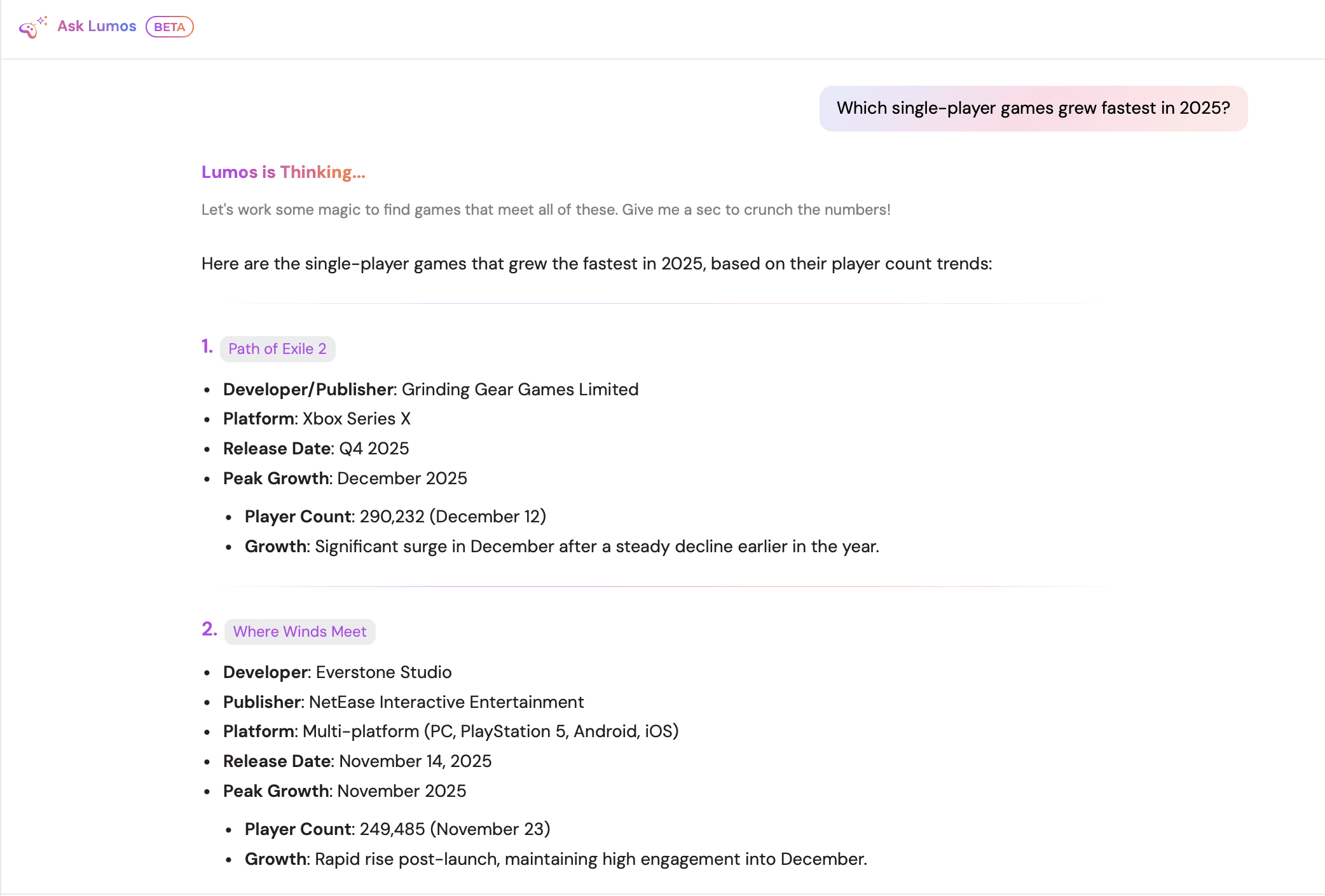
“Which single-player games grew fastest in 2025?”
“How crowded is the market for turn-based RPGs?”
“What mechanics consistently perform well in mid-budget roguelites?”
Lumos answers with intelligence grounded in the most trusted foundation of metadata in gaming.
Before Lumos vs After Lumos
Before Lumos | After Lumos |
|
|
Validation isn’t about slowing down creativity. It’s about ensuring creativity is pointed at something players actually want.
The Value of Lumos: Confidence You Can Build On
Speed is great. Efficiency is great. But a vital outcome of validation is confidence:
Confidence to greenlight
Confidence to pitch to stakeholders
Confidence that your idea belongs in its market
Confidence that your team is aligned
Confidence that you’re not building to a dead-end
In an industry where the cost of being wrong is enormous, confidence is a competitive advantage.
Assumptions Are Expensive. Validation Isn’t.
Every studio pays for validation. Some pay upfront. Most pay later — through rework, delays, or projects that quietly fade away.
Teams that win are the ones that validate early, align quickly, and build with clarity instead of guesswork.
Because the real gamble in game development isn’t trying something new. The real gamble is committing without knowing.
Make Hits. Not Bets.
Harish Alagappa
Senior Content Writer
@Gameopedia
Senior Content Strategist. Played an irresponsible amount of Left 4 Dead 2 in college. Now I spend far too much time on Settlers of Catan. Favorite games? Ghost of Tsushima and Crush, an obscure PSP title that deserved better. I believe video games are the defining artform of our time. Why? Stick around and find out.