Lumos Pitch Analysis: Is Your Game Idea Ready for the Market?
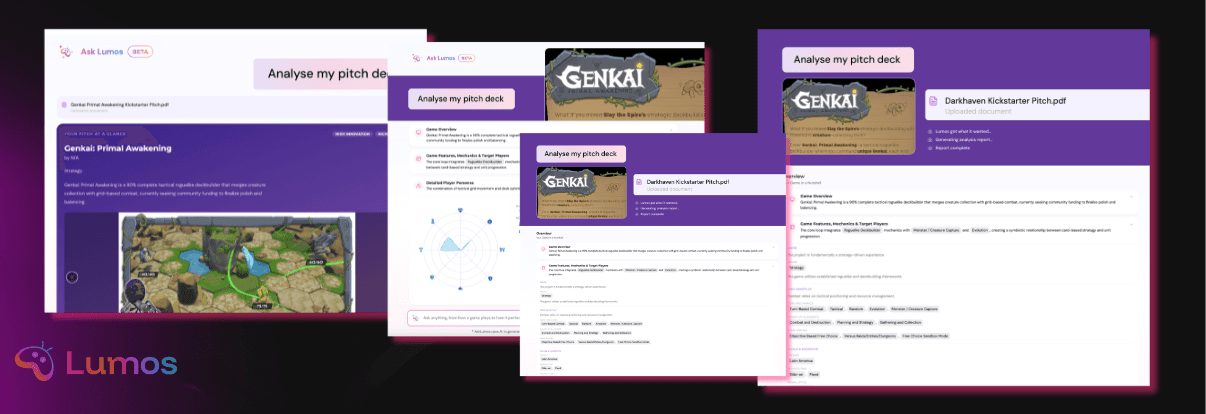
Game pitches often rely on instinct, scattered research, and a handful of comparable titles. Lumos Pitch Analysis changes that by evaluating your pitch deck against real market signals. Upload your deck and instantly see strengths, risks, and missing elements before you pitch publishers or investors.

Shrutesh Kumar

Every game pitch starts with optimism (and maybe a little bit of denial).
Here's a familiar tale: A small team has an idea that feels right. Maybe it’s a narrative game about rebuilding a town in a post-post-dystopia. Maybe it’s a roguelike deckbuilder with farming mechanics and existential dread. Maybe it's an action game set in a universe where guns were never invented.
Whatever it is, the team is motivated. They believe this is IT. This is the idea that's going to change the landscape of gaming forever. All they need is someone to invest in them and their game.
And so, a pitch deck is prepared.
The slides get polished until they gleam. Gameplay loops are turned into elegant diagrams that look like crop circles. Concept art is carefully placed next to phrases like “deep systemic engagement” and “emergent storytelling.”
Then, the pitch goes out into the world. To publishers. To investors. To platform teams who have seen more "innovative platformers" than there are grains of sand in the Sahara.
At that moment, the pitch stops being a dream and becomes a cold, hard question: Is this idea actually aligned with the market, or is it just a beautiful hallucination?
The Two Classic Pitch Disasters
A pitch deck isn’t a story. It's not about why your game is cool or awesome or innovative. It’s an argument for why the market should care that you exist.
If you’ve been around game development long enough, you’ve probably seen these tragedies play out in real-time.
1. The Echo Chamber Pitch
The team spends months refining a concept. Everyone internally loves it. The Discord is hyped. Your friends say it’s "neat." Then the pitch reaches a publisher, and the response is polite but devastating: “This looks promising, but the genre is currently saturated.” What felt like a unique spark inside the studio turns out to be one of dozens of identical sparks in a very crowded room.
2. The Missing Information Pitch
The idea is brilliant. The art is gorgeous. The gameplay loop is tighter than a gymnast's grip. But the deck lacks the signals publishers actually use to justify spending millions: traction metrics, audience validation, and financial clarity. You get the familiar, soul-crushing response: “We’d like to see more validation.”
Neither of these happens because of a lack of talent. They happen because the pitch was never tested against the cold hard gaze of market reality.
Enter Lumos Pitch Analysis: Your Market Reality Check
Pitch Analysis is a new feature in Lumos that evaluates your deck and compares it against real-world market signals. Instead of manually scouring SteamDB or pretending you understand the "current zeitgeist," you can upload your deck and receive a structured reality-check in seconds.
Think of it as pressure-testing your concept against structured market intelligence built from years of real game performance data.
Step 1: The Upload
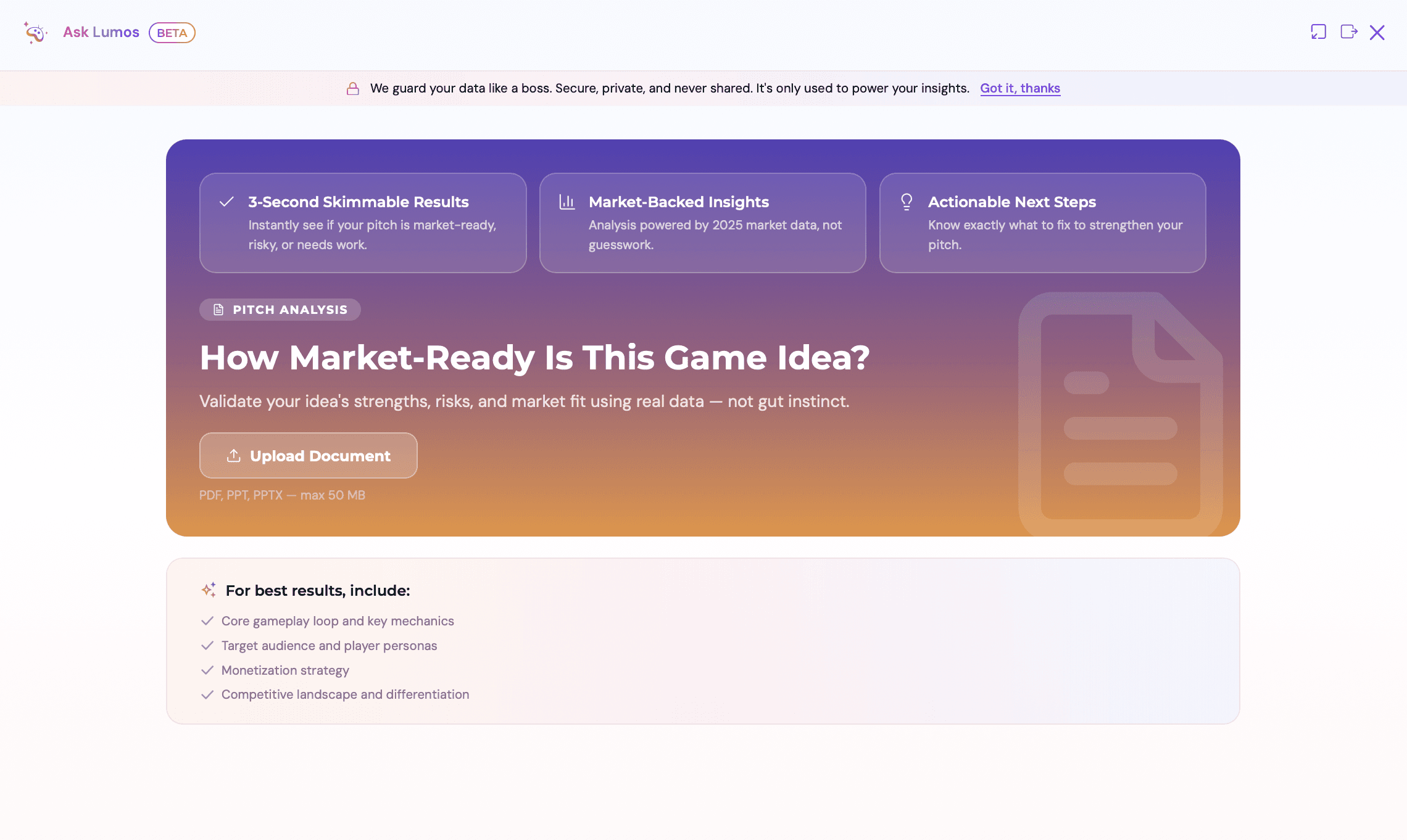
You upload your pitch as a PDF or presentation. Don't worry about the template, just share it as you would to a potential investor.
Step 2: The Deconstruction
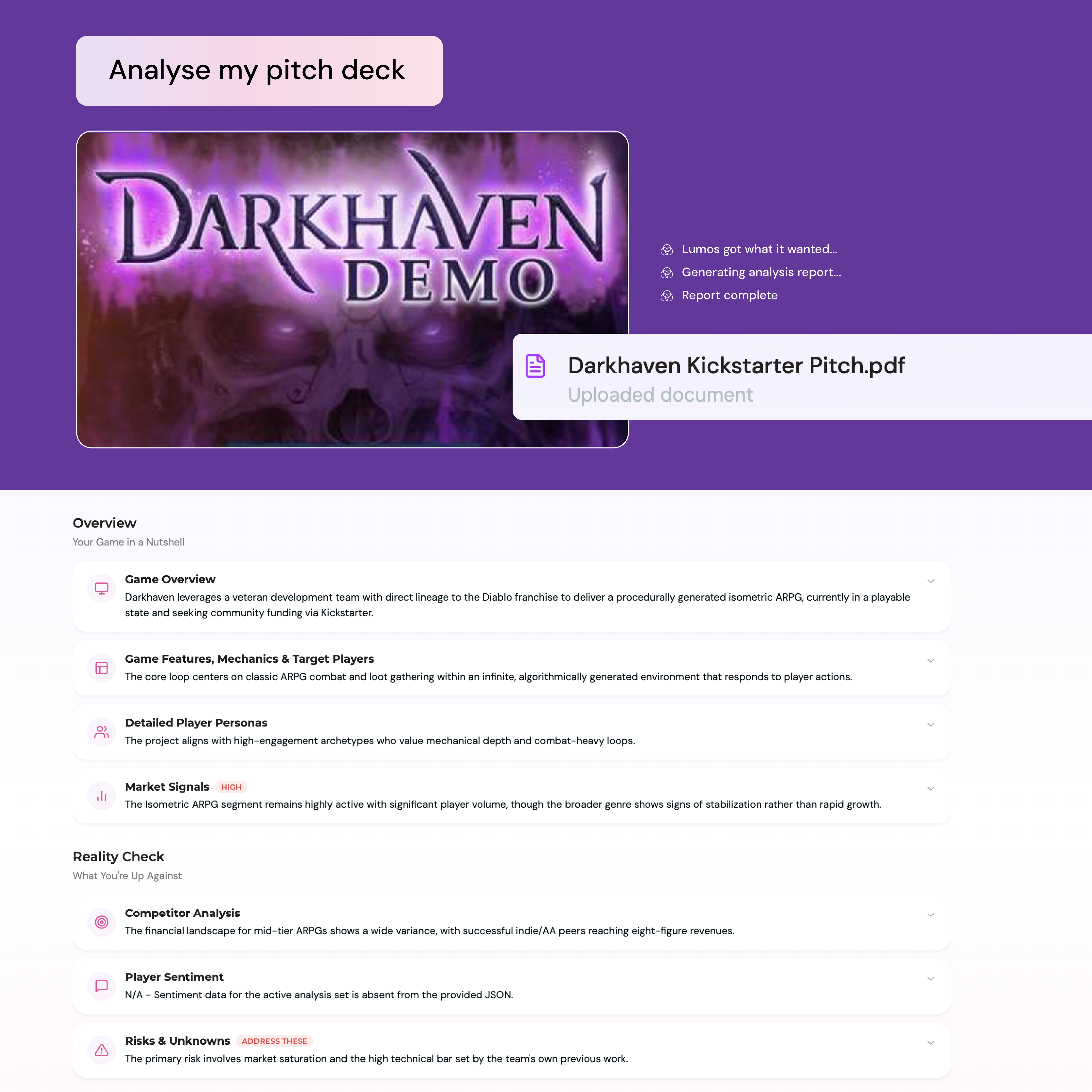
In about a minute, Lumos extracts the DNA of your project: mechanics, genre positioning, monetization assumptions, and comparable market examples.
Step 3: The At-a-Glance Audit
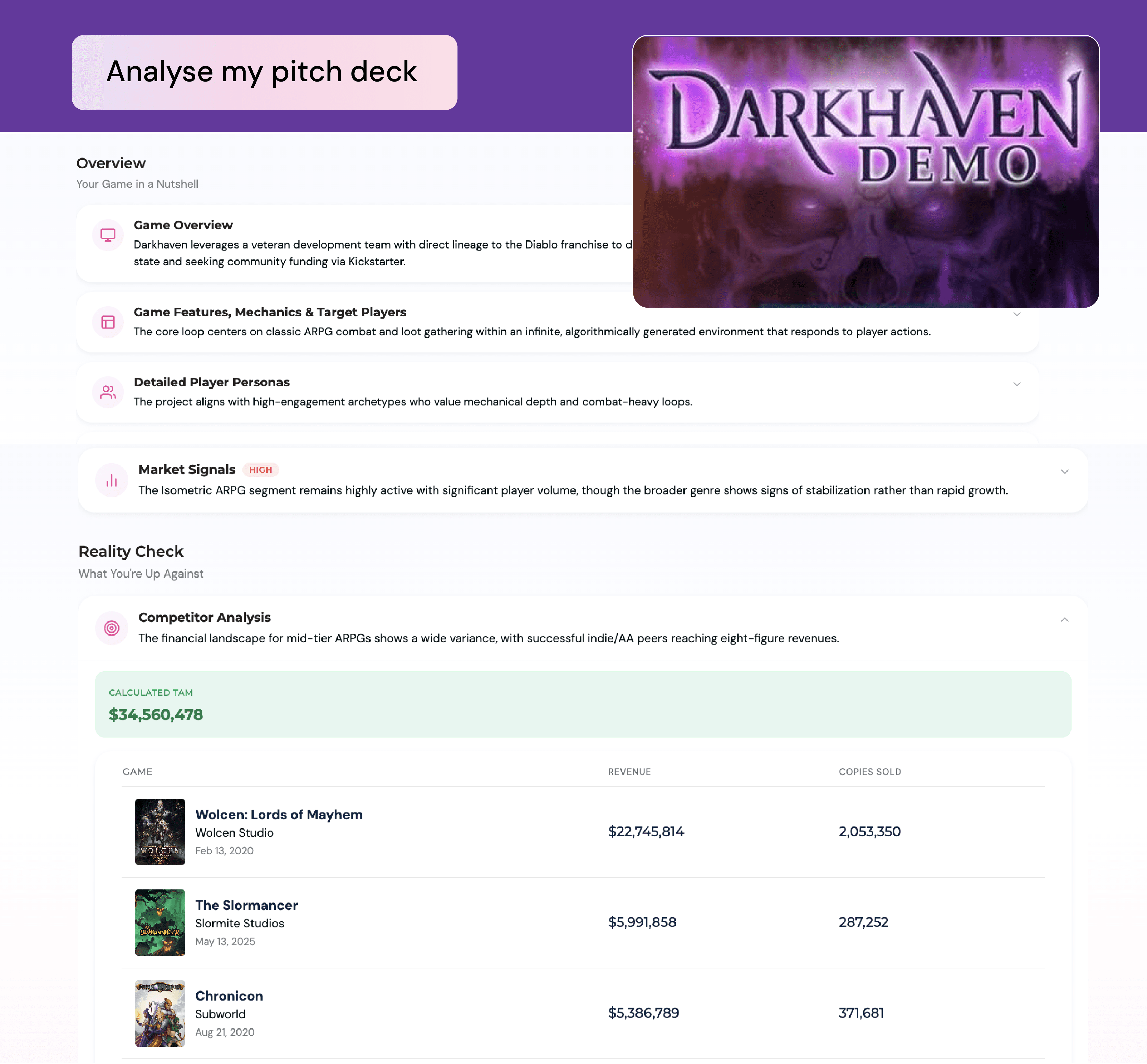
You immediately see a reconstruction of your core thesis: platform strategy, pricing, and team composition. But the real value is the Market Reality Check.
Teams don’t just use this once. Pitch Analysis becomes part of an iterative workflow, refining positioning as features evolve, as market signals shift, and as the project moves from concept to production to launch planning.
Strengths, Risks, and the Honest Truth
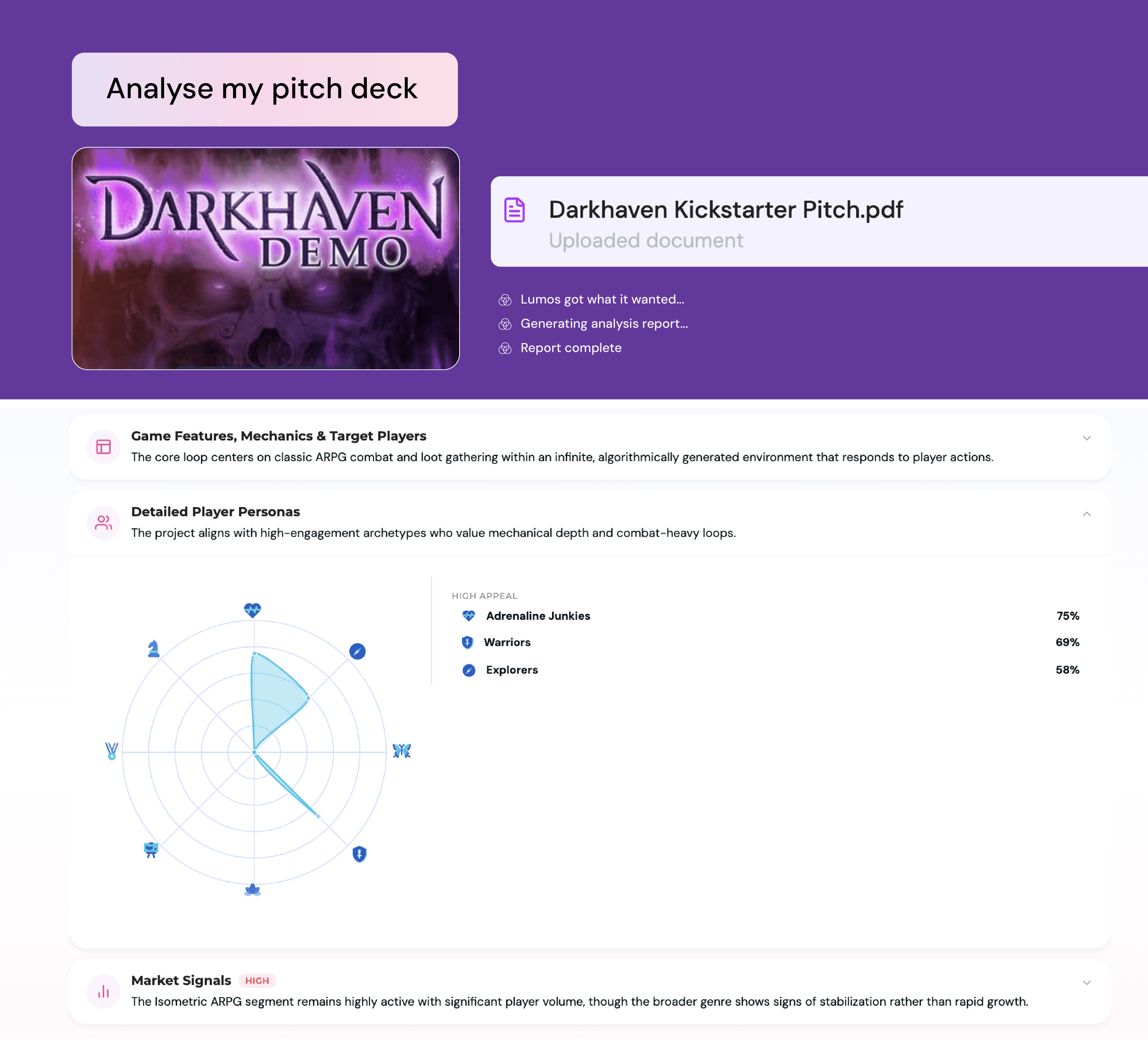
Lumos surfaces the signals publishers use behind closed doors:
Competitive Density: Are you entering a "Red Ocean" where everyone is fighting for the same players?
Genre Trends: Is your "wholesome narrative" riding a wave or hitting a cliff?
Missing Links: Most strong pitches fail because they omit the boring stuff: financial projections, wishlist traction, or community signals. Lumos highlights these gaps before you're sitting in a meeting with a blank expression.
These signals aren’t meant to replace creative intuition. They exist to ensure creative ambition is grounded in market reality.
This Isn’t Just About Pitching. It’s About Choosing What To Build
Most teams think of pitch decks as fundraising tools. But in practice, a pitch deck is a compressed version of your entire product strategy.
It reflects decisions about genre, audience, platform focus, monetization assumptions, and market timing. If those decisions are misaligned, refining the deck won’t fix the underlying problem.
Pitch Analysis helps teams surface strategic blind spots earlier. Not just to improve how a game is presented, but to improve the decisions that shape the game itself.
Because the real cost of misalignment isn’t a rejected pitch. It’s years spent building the wrong thing.
Why This Matters
Game development is a high-risk, long-horizon investment. The worst outcome isn't getting a "No" from a publisher. The worst outcome is spending three years and your entire life savings discovering that your core concept was misaligned with reality from Day One.
Pitch Analysis shifts that discovery to the present. It’s the "Go Touch Grass" moment for your business strategy.
Instead of relying on instinct and good vibes, you can validate your ideas against real signals in minutes.
For studios, this is about more than improving pitch success rates. It’s about reducing strategic risk across the entire development lifecycle.
From greenlighting concepts to prioritising roadmap investments, structured market intelligence changes how teams decide what to build.
Because sometimes the most valuable feedback is the one you receive before you press "Send."
Start your Lumos two-week free trial and pressure-test your next game idea against real market signals before you commit months (or years) to building it.
👉 Try Lumos Now
Shrutesh Kumar
Product Management
@Gameopedia
Shrutesh has a decade of experience as a game analyst. When he is not preaching about video games, He is busy telling anyone who listens that Mass Effect is the best game series ever made!