What Different Player Personas Actually Care About (And How to Design for Them Without Guessing)
Sometimes, games don’t fail because of bad design. They fail because they’re built for the wrong players.

Harish Alagappa

Most game teams say they are building “for players.” Very few can clearly answer the more uncomfortable question: Which players?
“Gamers” are not a single audience. They are a collection of competing motivations trying to coexist inside the same product. The same mechanic that keeps one group engaged can quietly push another away.
So when a feature underperforms or reviews feel polarized or retention curves behave unpredictably, the issue is often not execution, it's audience mismatch.
Understanding player personas is no longer a marketing framework. It's a product risk signal.
And today, it's measurable.
The Flaw in Traditional Persona Work
Most studios already have persona frameworks tucked away in decks or strategy docs. They describe psychological profiles and behavioural tendencies in useful but abstract ways.
What they rarely show is: How those motivations actually translate into market reactions once a game is live.
This is where Lumos becomes operational.
Instead of treating personas as theoretical archetypes, Lumos helps teams observe:
How different player motivations show up in sentiment
Which mechanics consistently trigger praise or frustration
Where genre audiences cluster around specific expectations
Early signals that a roadmap is drifting from its intended audience
Personas stop being descriptive and start influencing product decisions.
From Bartle’s Taxonomy to Modern Market Intelligence
The concept of player types is not new.
Richard Bartle’s taxonomy of Achievers, Explorers, Socializers, and Killers gave the gaming industry its first structured vocabulary for player motivation. But today’s market reality is far more fragmented.
Genres blend, live service updates reshape expectations weekly, social dynamics redefine retention, monetization models influence behaviour.
Lumos builds on this lineage by connecting motivational theory to observable market intelligence, mapping how different player motivations respond to real design decisions across comparable titles.
Not as personality theory. As design intelligence.
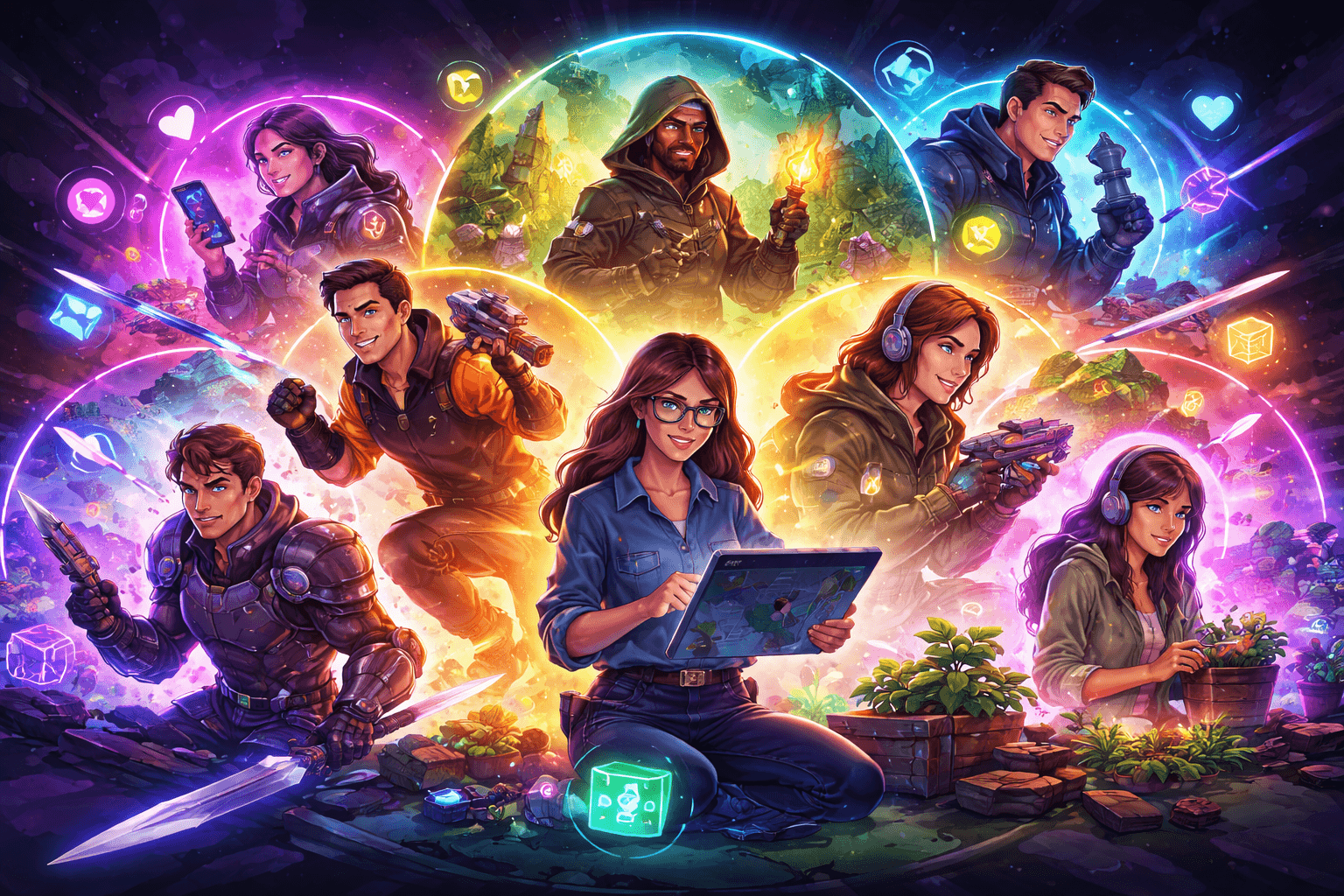
Lumos Player Personas (and What They Actually Signal)
Persona | Core Motivation | What This Means in Production | How Lumos Helps Teams See It Earlier |
|---|---|---|---|
Adrenaline Junkies | Momentum & Flow | Friction-heavy systems kill engagement even in mechanically strong games | Reveals pacing expectations and sentiment patterns in fast-paced genres |
Challengers | Mastery & Recognition | Difficulty only works when skill expression feels visible | Surfaces reactions to progression clarity and challenge tuning in comparable titles |
Social Gamers | Community & Shared Experience | Retention is often driven by ecosystem health, not mechanics | Highlights sentiment shifts tied to multiplayer and social systems |
Planners | Strategic Depth | Over-simplification reduces long-term engagement | Shows how depth expectations vary across strategy-driven genres |
Warriors | Competitive Legitimacy | Perceived unfairness creates emotional backlash faster than imbalance itself | Tracks sentiment patterns around power progression and tuning decisions |
Explorers | Meaningful Discovery | Large worlds without meaningful discovery feel empty quickly | Identifies how exploration systems influence reception in open-world titles |
Creators | Identity & Expression | Customization systems often become core retention drivers | Reveals long-tail engagement patterns linked to player expression |
Zen Gamers | Emotional Regulation | Stress creeping into calming experiences leads to silent churn | Surfaces tone and pacing expectations in relaxation-focused genres |
The Hidden Danger: Persona Conflict
Most modern game feedback isn’t simply positive or negative.
It is polarized.
Different player motivations respond differently to the same design decision.
What looks internally like product uncertainty is often audience clarity emerging too late.
By mapping sentiment patterns and feature reactions across comparable games, Lumos helps teams identify:
where persona expectations conflict
which audience segments a game is actually satisfying
how design trade-offs will likely be received
Not to eliminate disagreement.
But to make disagreement predictable.
Stop Guessing. Start Aligning.
The strongest games are rarely universally loved. What they are is precisely aligned.
Understanding what different players actually care about helps teams:
interpret mixed feedback with context
prioritize features with clearer rationale
reduce roadmap risk
validate audience alignment earlier
Lumos gives teams a way to connect player motivation theory with real market reactions before major development decisions are locked in.
Because building the right game usually starts with understanding which players you are truly building for.
Ready to see how your concept resonates across real player motivations?
Try Lumos Free
Harish Alagappa
Senior Content Writer
@Gameopedia
Senior Content Strategist. Played an irresponsible amount of Left 4 Dead 2 in college. Now I spend far too much time on Settlers of Catan. Favorite games? Ghost of Tsushima and Crush, an obscure PSP title that deserved better. I believe video games are the defining artform of our time. Why? Stick around and find out.