Player Sentiment Analysis in Lumos is Live! Here’s Why That Matters.

How sentiment analysis in Lumos helps studios understand player sentiment, spot issues early, and make better decisions.

Shrutesh Kumar

Sentiment Analysis is now live in Lumos.
You can now see how players feel about a game broken down across 12 major topics and 23+ sub-topics, backed by evidence volume, and mapped to specific update events.
And more importantly: You now have a sentiment analysis system that helps you decide what to do next.
What is Sentiment Analysis for Games
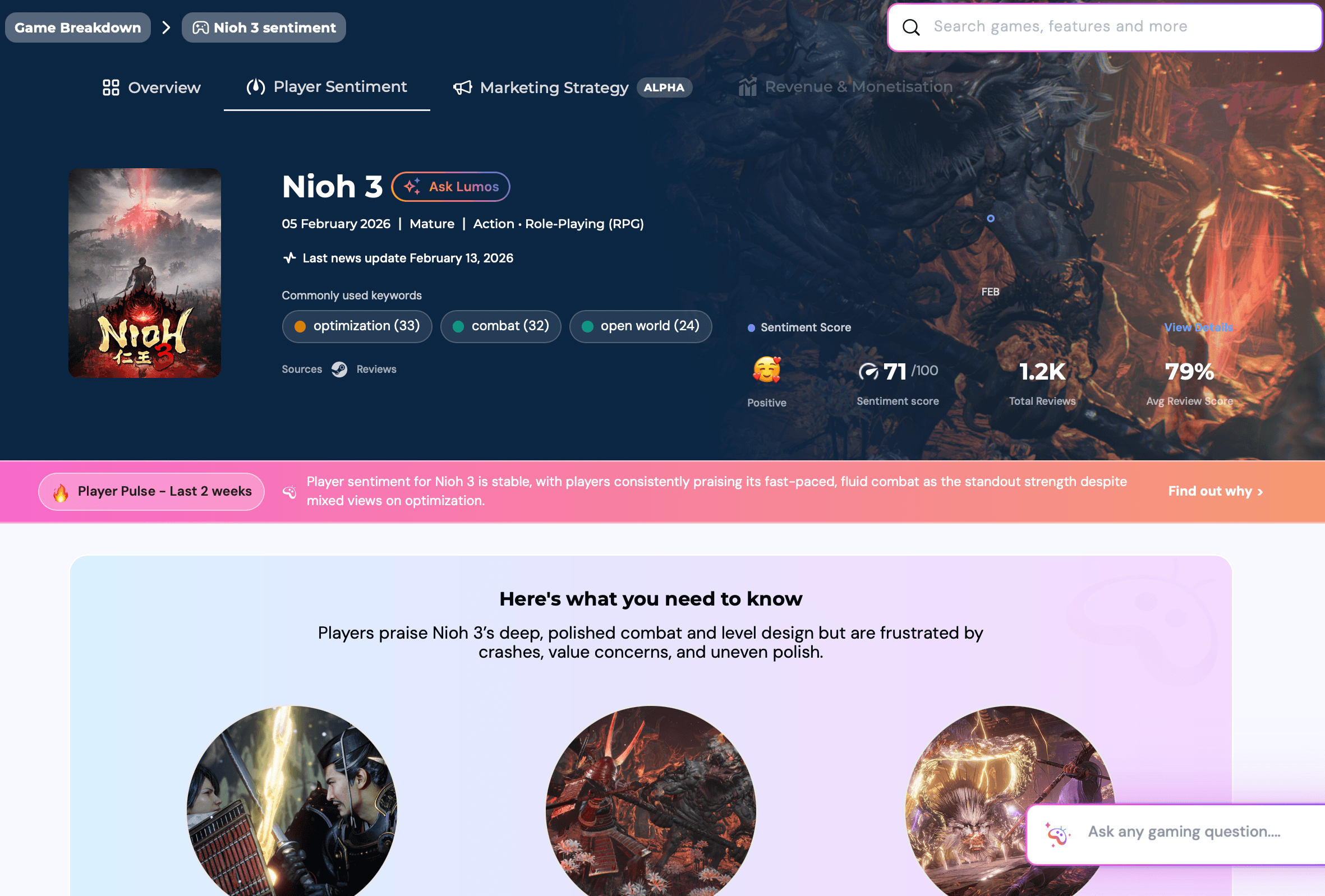
Sentiment analysis for games is the structured analysis of player feedback to understand how players feel about specific aspects of a game. Also known as opinion mining, sentiment analysis in the video game industry is the process of analyzing large volumes of textual data to identify customer sentiment and specific emotions to determine whether players are responding with positive sentiments, negative words, or are neutral about various aspects of a game.
What makes sentiment analysis important for game teams goes beyond customer satisfaction or counting positive and negative words.
Performing sentiment analysis allows game development teams to sift through large volumes of qualitative data to parse emotional tone at scale. It's like conducting market research with better surveys, as it highlights real customer experiences in real human language and enables teams to make informed decisions that can use gaming data to make better games and improve experiences and brand perception.
In Lumos, that means:
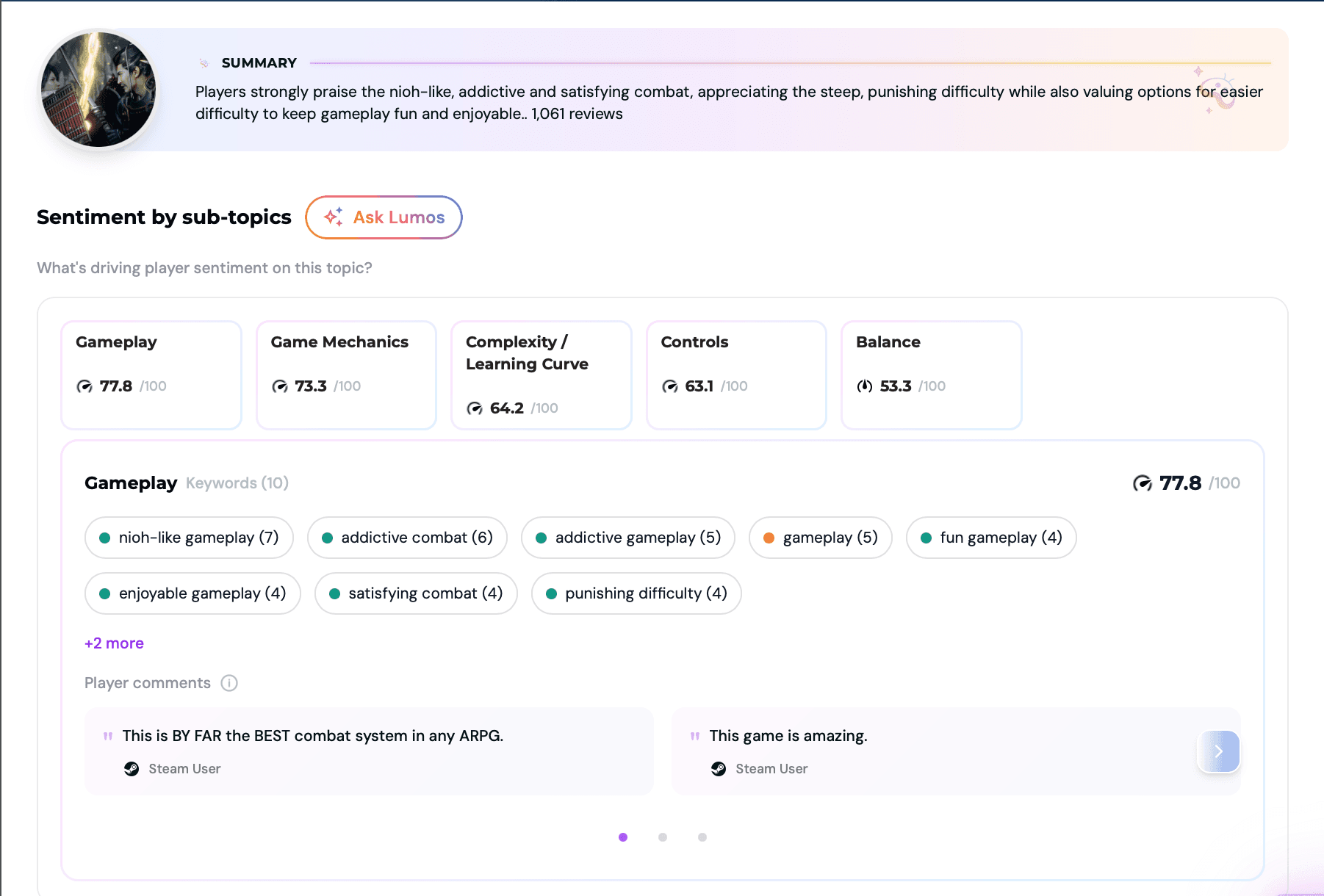
Aggregating thousands of Steam reviews
Classifying them across 12 topics and 23+ sub-topics
Quantifying sentiment with a score
Showing evidence volume behind each signal
Mapping shifts to update events over time
Lumos' sentiment classification system analyses textual data across thousands of Steam reviews, assigning each of them a sentiment label — positive, negative, or neutral — and an overall sentiment score. Combining the overall sentiment scores helps determine sentiment trends.
Instead of having to read thousands of reviews, you get a structured, decision-ready insight. By using sentiment analysis, game developers can analyze sentiment and opinion mining at scale to make data-driven decisions for whether they should incorporate a particular feature or gameplay element or storytelling trope based on how players have responded to those same elements or tropes elsewhere.
What Was the Problem With Customer Feedback?
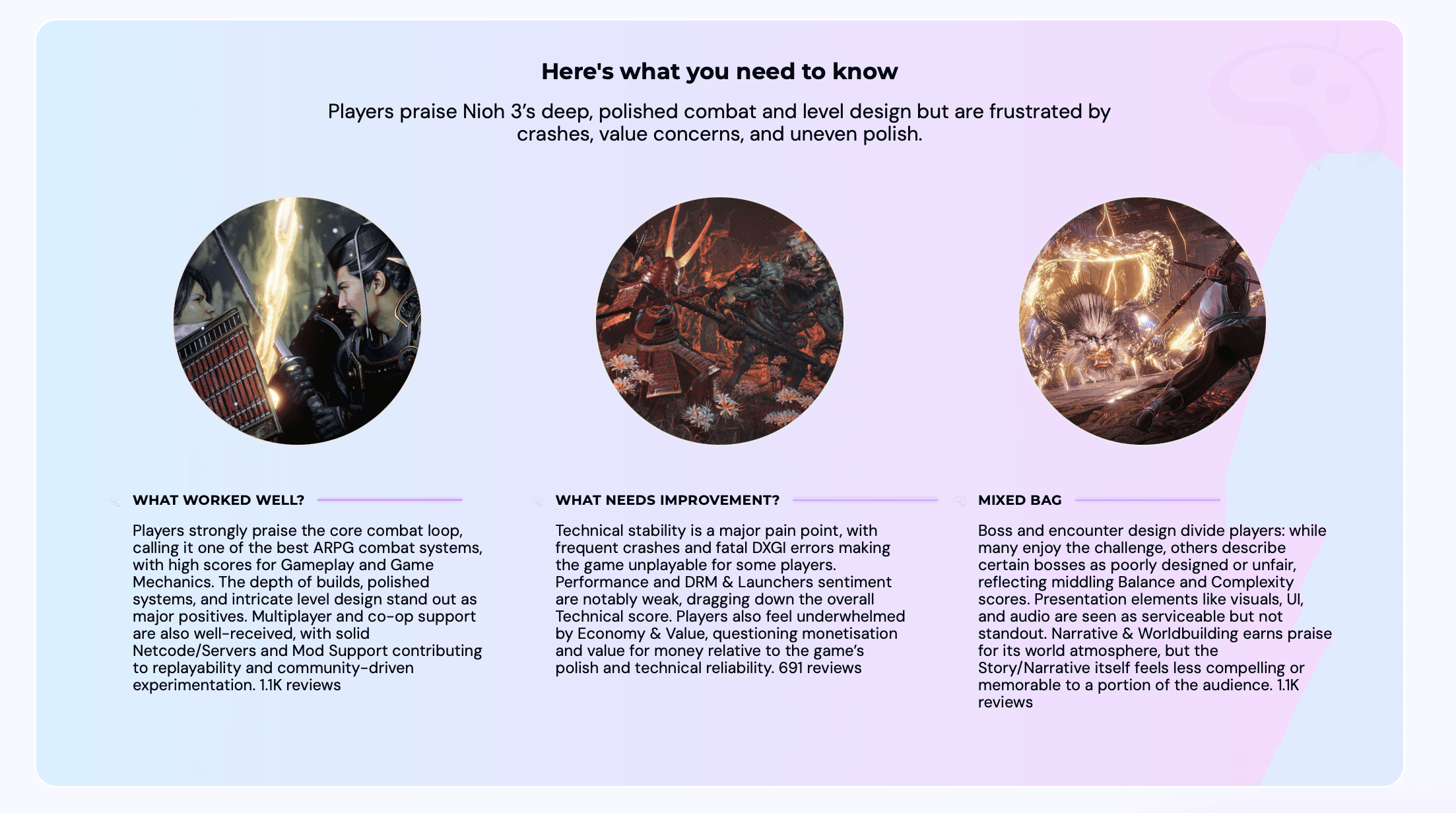
You might be thinking, "Why do we need this, we already get feedback from gamers?" And you're right. Gaming has one of the most vocal communities out there.
Steam reviews. Discord threads. Reddit. YouTube comments.
However, access was never the problem.
The problem was scale and signal clarity.
When 7,500 players mention performance issues, that is structurally different from three loud Reddit threads. Lumos sentiment analysis tools are designed to process large volumes of unstructured data, enabling reliable analysis and real-time insights from Steam reviews.
Why Steam reviews? Because we can map every review against players who have actually bought and engaged with the game. Reddit and social media platforms have valuable insights, but are also prone to farming, particularly with the emergence of AI tools that can create fake reviews at scale.
Without evidence volume, noise can look like trend. Without structure, emotion can look like signal.
Lumos separates signal from noise by:
Counting how many mentions support a sentiment
Scoring sentiment numerically
Showing topic-level breakdowns
Mapping shifts to updates
This approach allows companies to analyze vast amounts of unstructured data efficiently, ensuring that decisions are based on reliable analysis rather than anecdotal evidence.
You’re not reacting to loud voices.
You’re reacting to weighted evidence.
How Does Lumos Actually Structure Aspect Based Sentiment Analysis?
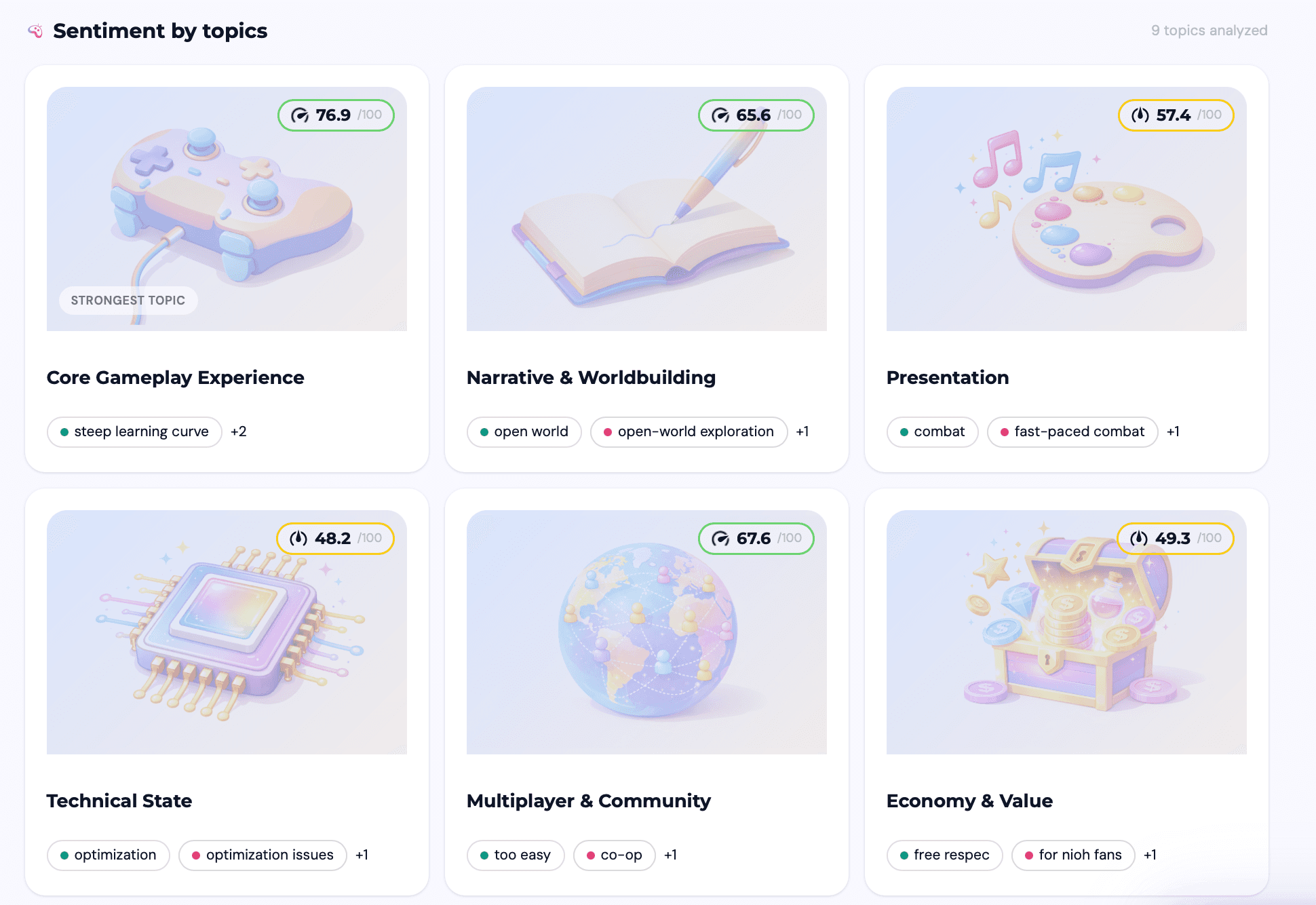
Lumos analyzes Steam reviews across:
12 high-level topics (Gameplay, Technical State, Economy & Value, etc.)
23+ sub-topics (Performance, Netcode, DRM, UI, Progression, etc.)
Keyword clusters in player language
Evidence volume per topic
Sentiment-over-time aligned to update markers
The sentiment analysis model in Lumos classifies player feedback by using a combination of rule-based and machine learning methodologies, leveraging both approaches to enhance accuracy and speed. The sentiment analysis software interprets the sentiment expressed in each review and produces structured sentiment analysis results for each topic and sub-topic. The underlying machine learning model is trained on large datasets to improve the accuracy of sentiment classification and handle complex language patterns, including sarcasm and idiomatic expressions.
Let’s take a real example.
Patching Up Marvel Rivals
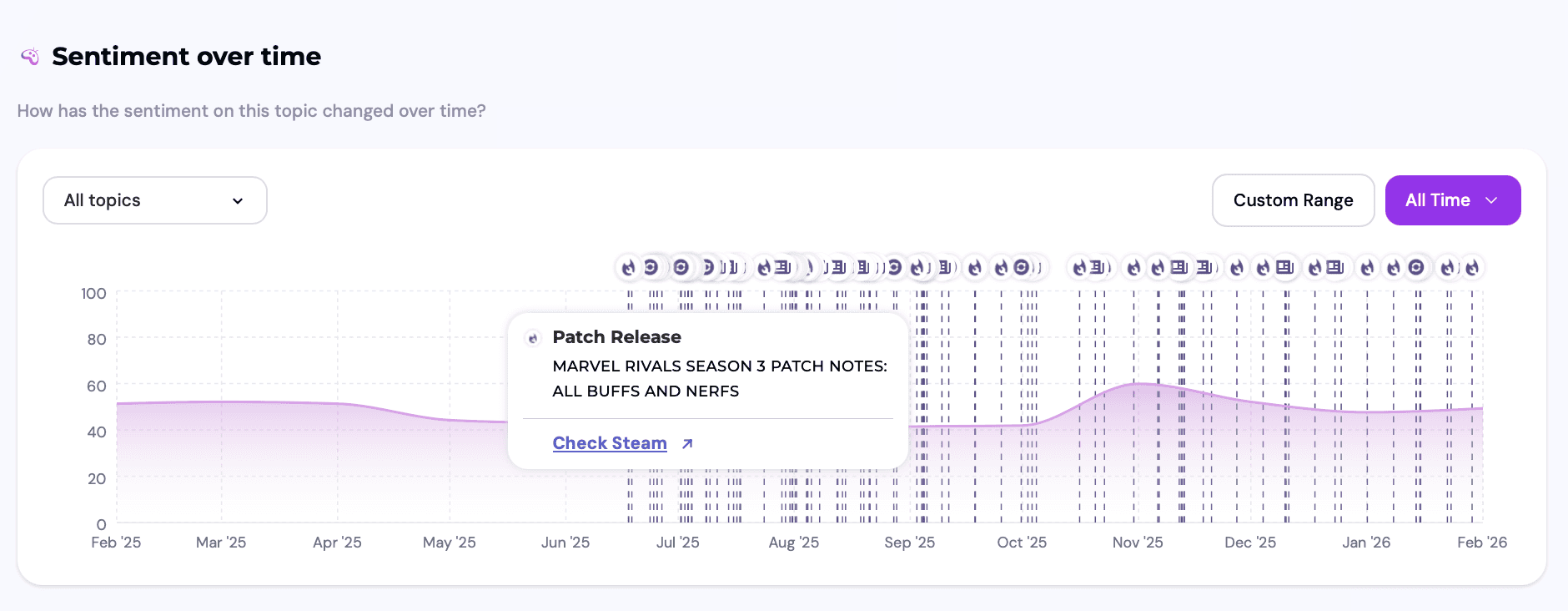
Between October to November 2025, Marvel Rivals saw their player sentiment score increase by 43%. This was largely the result of a series of tactical patches and upgrades that came about from developers listening to the community.
This is reflected in the improvement seen in the game's Live-Ops & Studio sentiment score as well as the improved Core Gameplay Experience score, which went up from 53 in October 2025 to 63.8 a month later.
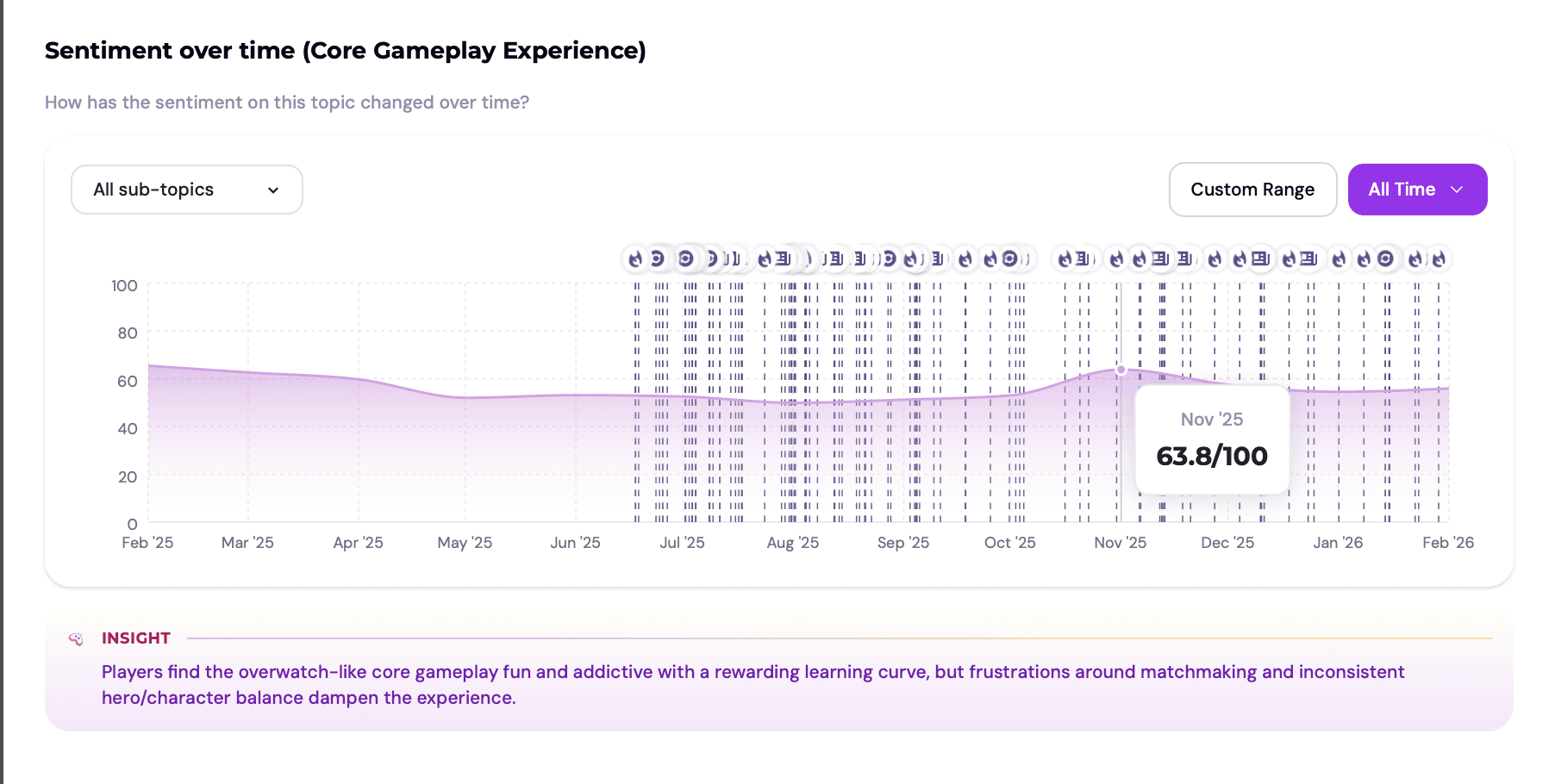
Lumos lets you track the individual patches, upgrades, and even news articles that influenced this increase, helping game teams with a granular understanding of what players are looking for and respond to, either positively or negatively.
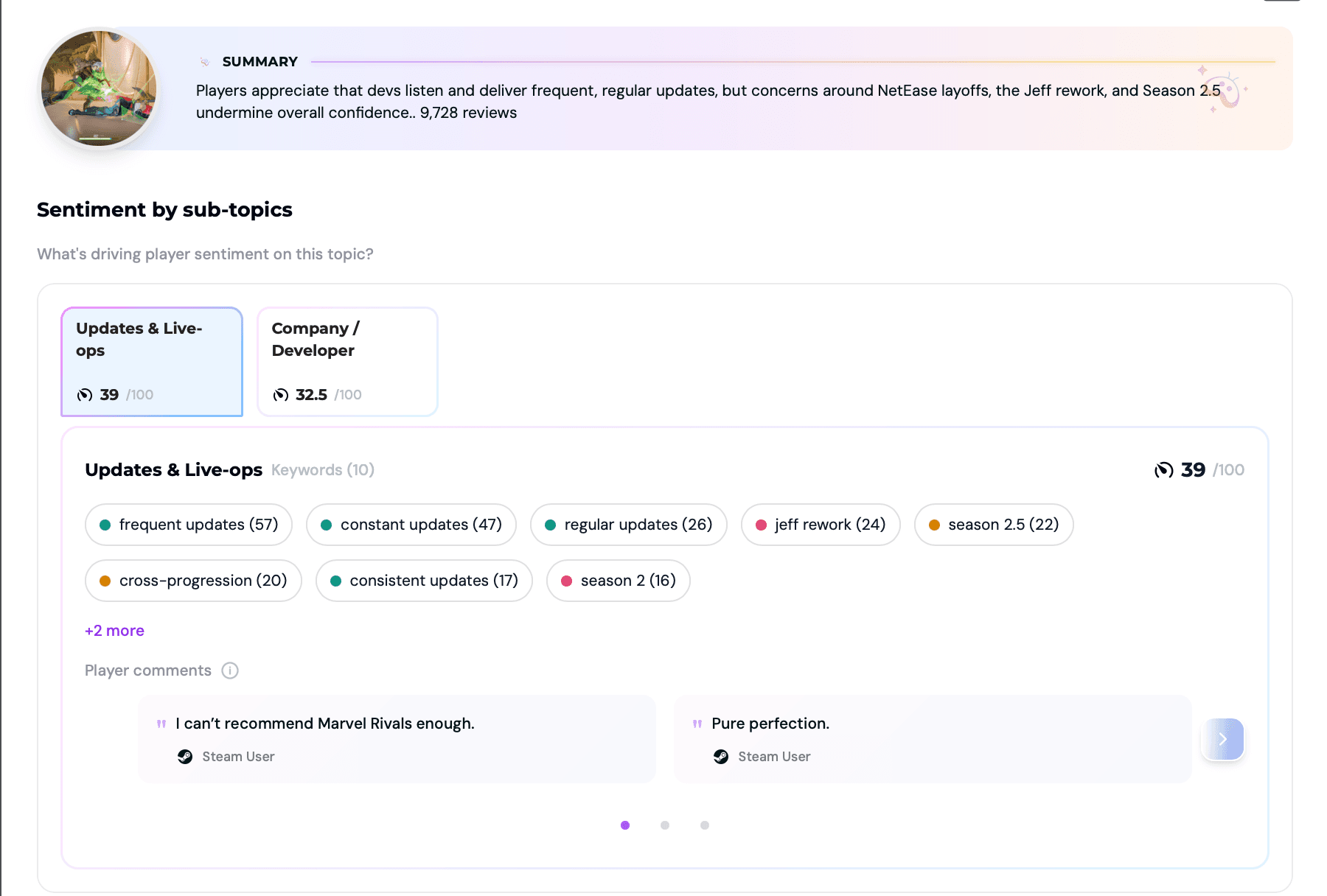
Lumos also highlights a selection of comments from Steam reviews that summarize the views of the player base.
How Do Developers Use Sentiment Score Data?
Developers use structured sentiment to prioritize correctly, especially when they also need deeper analysis of game mechanics and features to understand what actually drives engagement.
With aspect based sentiment analysis, developers can extract meaningful insights about particular aspects of the game, such as performance or gameplay features. This approach helps identify whether specific features are meeting customer expectations or causing dissatisfaction, enabling targeted improvements.
Example:
Gameplay: 51
Economy & Value: 55
Technical State: 30
You don’t need a debate.
The core loop works. The game runs badly.
That’s your sprint priority.
Sentiment prevents:
Chasing loud but low-scale complaints
Fixing secondary issues before primary ones
Arguing based on anecdotal Slack screenshots
It replaces gut feel with weighted evidence.
How Do Community Teams Use Social Media Monitoring and Sentiment Data?
Community managers feel sentiment shifts first.
But feeling it and proving it are different things.
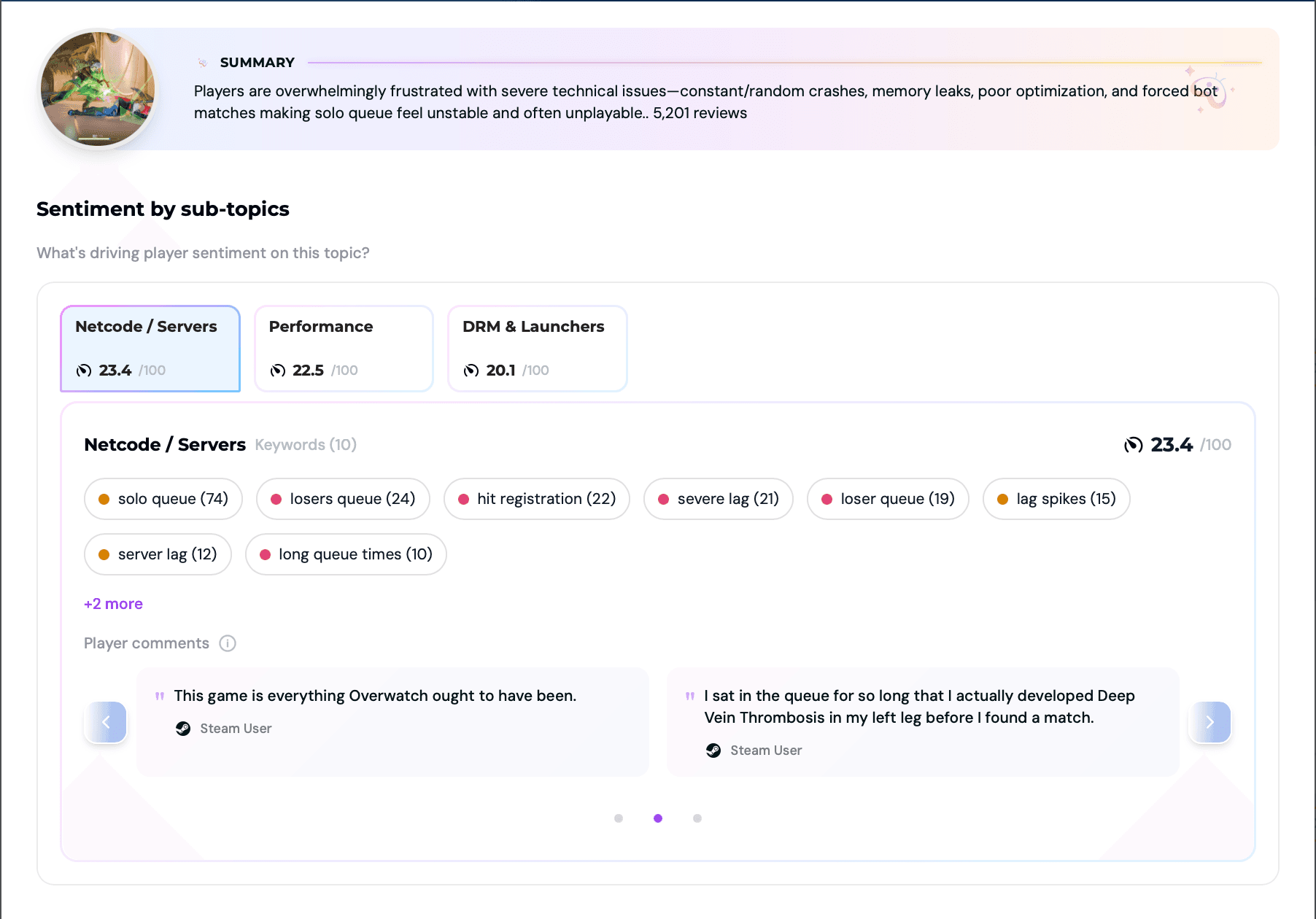
Sentiment analysis classifies feedback into sentiment categories such as positive, negative, or neutral sentiment, helping teams interpret the full range of player opinions. Accurately identifying neutral sentiment is important for understanding nuanced or mixed opinions in survey responses and community feedback.
By analyzing positive and negative sentiments in player comments and survey responses, organizations can better understand customer experiences and improve their services.
With Lumos, community teams can show:
When the drop started
Which sub-topic triggered it
How many mentions are involved
Whether it’s accelerating
Instead of:
“We think players are upset.”
You can say:
“We’ve had 3,200 negative mentions tied to performance in 48 hours.”
That changes internal speed and credibility.
Sentiment tends to move before retention does. Now you see it forming.
How Does Marketing Use Sentiment Analysis?
Marketing doesn’t just need crisis detection, it needs validated positioning supported by AI-powered strategic insights for game marketers.
High-sentiment clusters reveal how players describe your game when they’re positive.
If reviews repeatedly praise:
“tight gunplay”
“smooth 5v5 pacing”
“addictive extraction loop”
That’s more than branding language, that’s market-validated messaging.
Marketing teams also use sentiment analysis to monitor brand reputation across social media platforms and news articles. Social media monitoring with sentiment analysis helps brands track public perception and manage brand image in real-time, and can be paired with comparison tools for games, features, and market segments to size and prioritize opportunities. Analysts use sentiment analysis to monitor news articles for emerging trends and market opportunities.
Instead of guessing positioning, you amplify what players already love — at scale.
How Do Executives Use Sentiment Data?
For leadership, Lumos player sentiment feature is more than a fun dashboard. It's the canary in the coal mine.
You can see:
Which topic dropped
How sharp the drop was
How much volume supports it
Which update triggered it
Sentiment analysis results provide a comprehensive view of overall sentiment, enabling executives to validate and control sentiment classification for better business decisions.
Monitoring overall sentiment helps companies gauge public opinion, monitor brand reputation in real-time, and respond quickly to potential crises. Sentiment analysis can also help teams identify emerging trends, analyze competitors, and probe new opportunities.
That’s the difference between reacting to churn and anticipating it.
Negative sentiment often precedes retention impact.
Sentiment analysis lets you intervene before the damage is done, and our expert insights on game development and market trends show how leading teams are already using this kind of data to stay ahead.
Isn’t This What We Already Track Manually?
Manual tracking looks like:
20+ hours reading reviews
No topic comparison
No structured volume weighting
No time-series mapping
No update correlation
Lumos turns 16,000 reviews into:
Topic-level scores
Sub-topic drilldowns
Evidence-backed volume
Keyword clusters
Sentiment-over-time with update markers
Automated sentiment analysis tools and game analytics that go beyond raw player data powered by artificial intelligence and machine learning provide structured, actionable insights from large volumes of feedback, helping businesses understand how customers feel about their brands, products, and services, whether they’re on free, creator, or enterprise Lumos plans.
Lumos doesn’t replace judgment. It structures it.
What’s Live Now?
Sentiment Analysis in Lumos currently includes:
Steam review sentiment tracking
12 topic-level breakdowns
23+ sub-topic drilldowns
Evidence volume per topic
Keyword clustering
Player comment sampling
Sentiment-over-time with update markers
The Real Shift
Sentiment analysis in Lumos turns unstructured player emotion into structured, decision-ready evidence as part of Lumos’ broader AI-powered insight platform.
You don’t just see that players are unhappy.
You see:
Why
How many
Since when
And what changed
That’s the difference between reacting to noise and managing risk.
Explore Lumos.
Shrutesh Kumar
Product Management
@Gameopedia
Shrutesh has a decade of experience as a game analyst. When he is not preaching about video games, He is busy telling anyone who listens that Mass Effect is the best game series ever made!