Subnautica 2 Early Access: What Lumos Says the Sequel Must Get Right
Lumos analyzes Subnautica player sentiment to identify what the sequel needs to preserve, fix, and prove.

Harish Alagappa

Subnautica dropped in 2018 with a brutally simple premise: you crashed on an alien ocean planet. Figure it out. No map. No multiplayer. No hand-holding.
It made $214.8 million.
As Subnautica 2 hits Early Access the pressure is immense. 14 million wishlists. Co-op for up to four players. A full Games as a Service monetisation model. Unknown Worlds is swinging bigger than ever.
We ran both games through Lumos for a proper deep dive into what the data says they've gained, and what they've put at risk.
Subnautica 2 Wishlist Numbers: What the Data Reveals
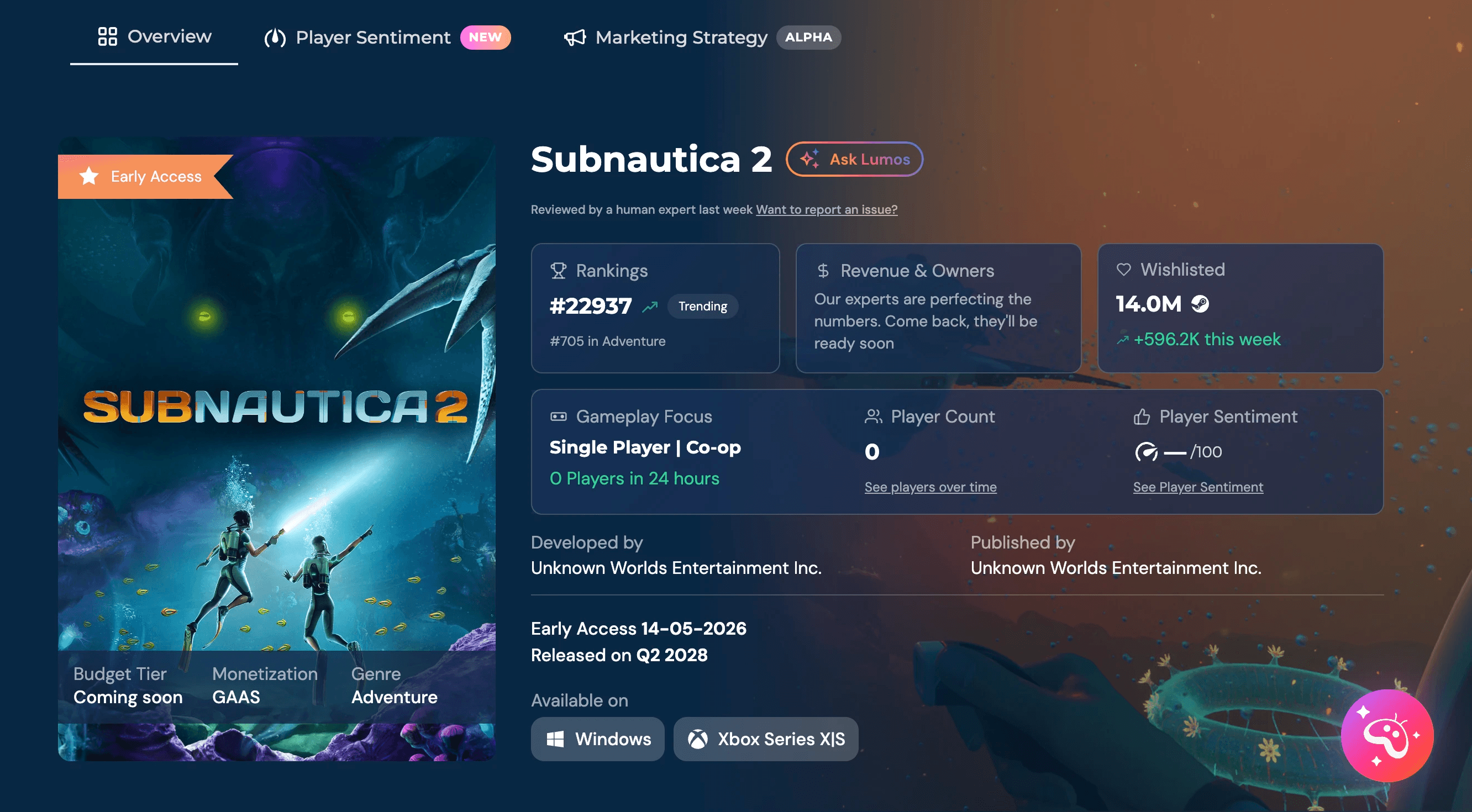
Before a single player review has surfaced, Subnautica 2 already has 14 million wishlists. The original sits at 9.4 million wishlists after eight years of sales and word of mouth.
That delta isn't just franchise loyalty. It's a signal that the survival-exploration genre has a demand ceiling far higher than the original ever reached, and that Unknown Worlds has the awareness to match it. Players aren't trickling in, they're flooding in before the gates even open.
The question, as always with highly anticipated sequels, is whether the product matches the current.
Subnautica 2 Player Audience: A Significant Shift
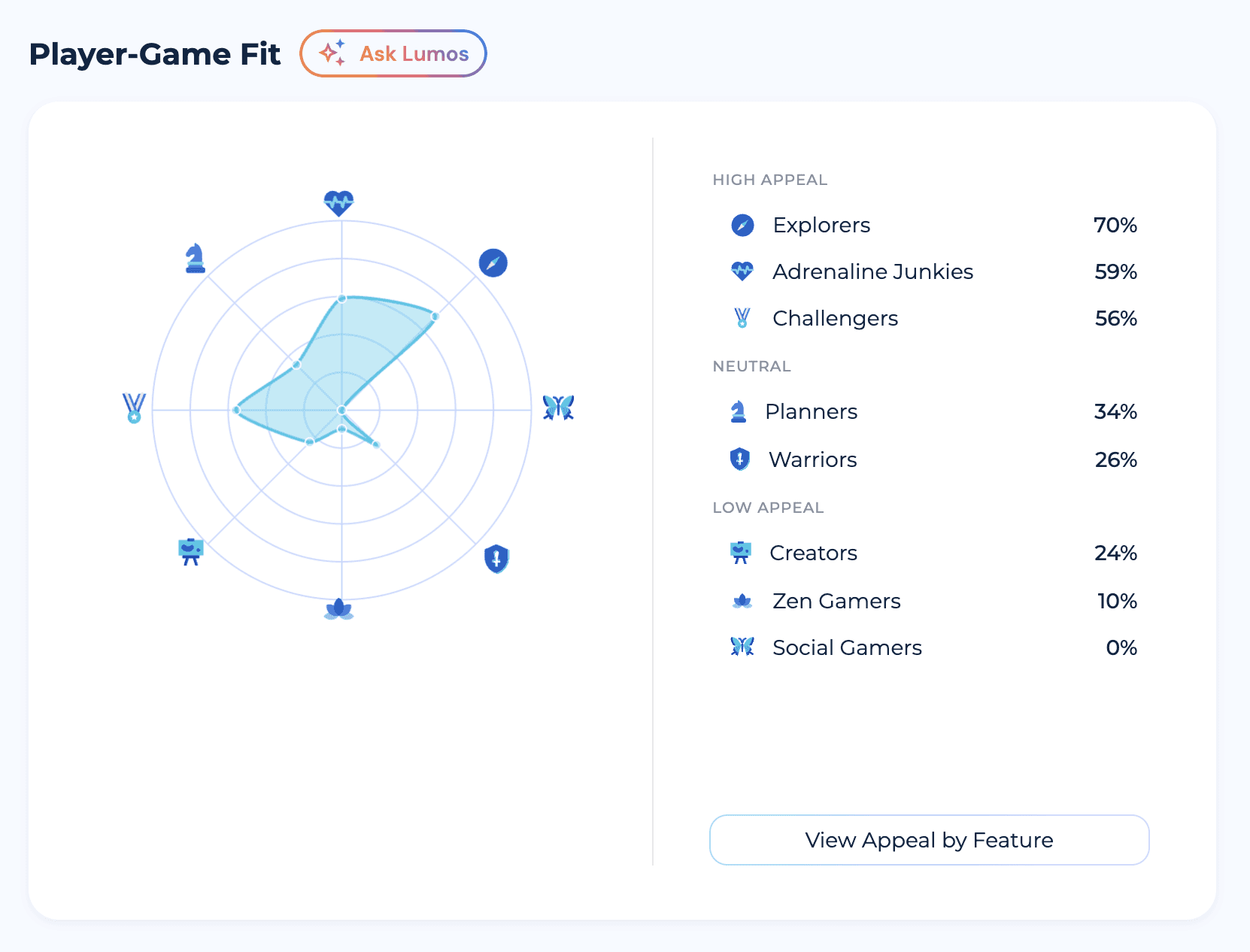
In the original Subnautica, Explorers dominated the audience at 70%. Players who love piecing together hidden narratives, mapping unknown systems, and diving deeper purely to see what's down there. The game was essentially designed as a gift to them.
Subnautica 2 tells a different story. Challengers are now the top player archetype at 54%, with Explorers just behind at 52%. It's a close split on paper, but it reflects a meaningful design shift: the sequel is built for mastery, difficulty, and systems complexity, not just discovery.
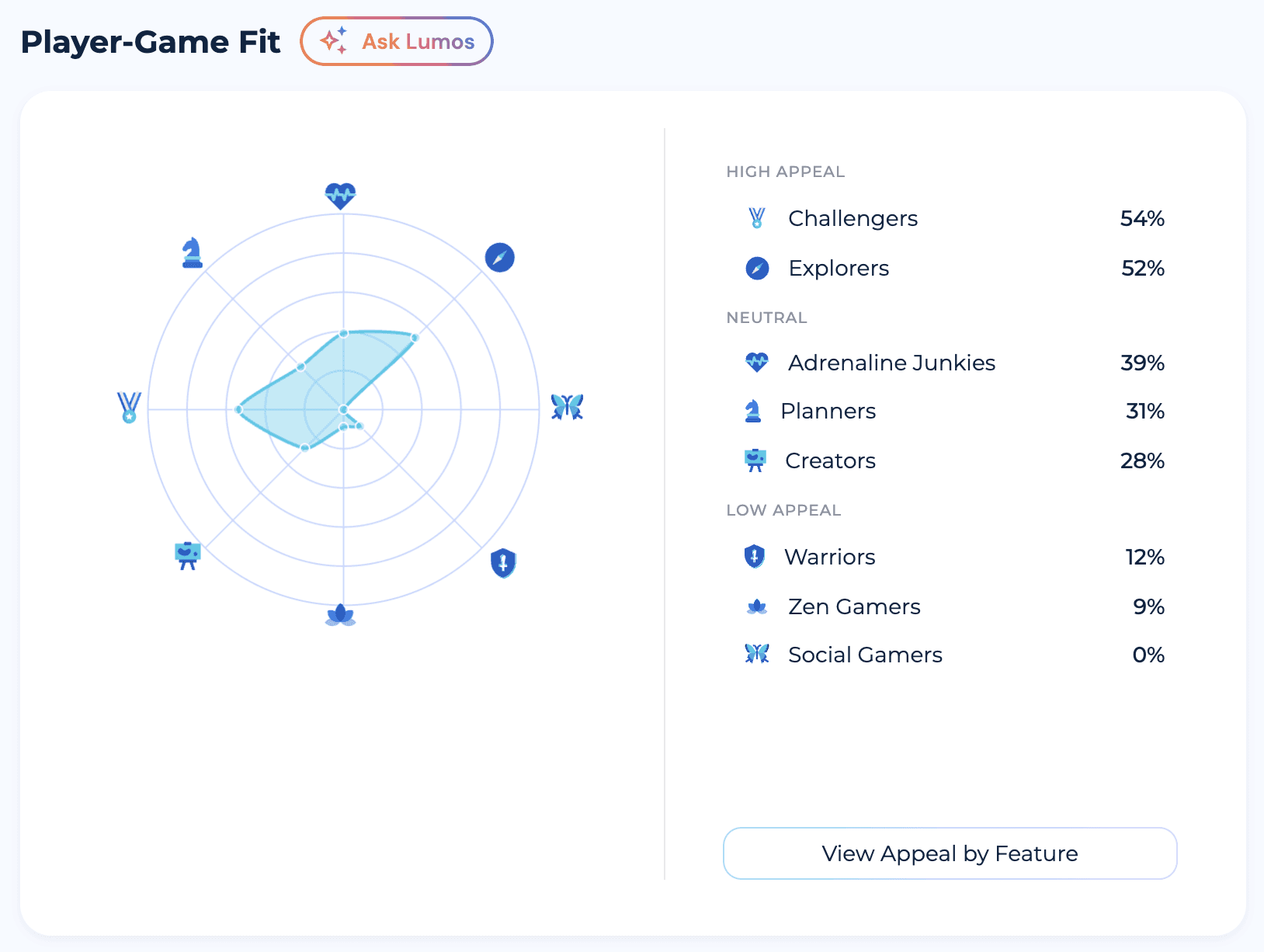
The additions back this up. Vehicle creation. Weapon crafting. Four-player co-op. These features don't appeal to the player quietly mapping coral caves alone. They appeal to the player who wants to optimise a build and test it under pressure.
The original's audience came for the mystery of the deep. The sequel is asking them to come for what they can build in it. Whether those two motivations can coexist without one drowning out the other is an interesting design question.
Why Narrative Is Subnautica's Strongest Asset
When we look at what drove Subnautica's player sentiment, Narrative & Worldbuilding scores 80.8 out of 100 the single strongest topic across 4,600 reviews. Higher than Core Gameplay. Higher than Presentation. Players weren't just trying to survive. They were investigating something that felt genuinely unknowable.
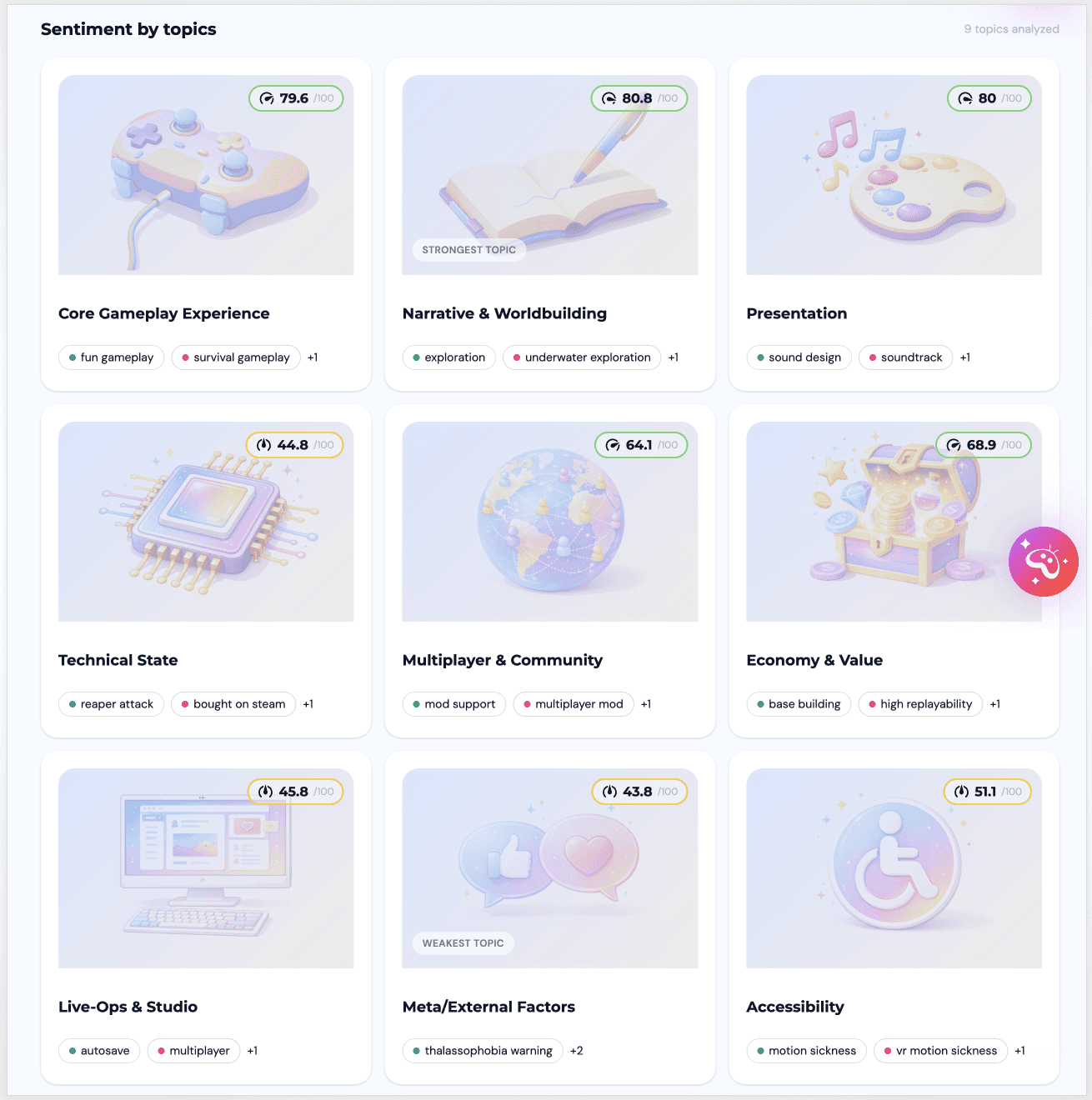
That's the current that runs through every positive review. The alien world, the crashed Aurora, the slow realisation that the ocean is hiding something far larger than you. Strip that out and you don't have Subnautica, you have a survival game with good water rendering.
The sequel's narrative suggests Unknown Worlds understands this at depth. Familiar themes (Sci-Fi, Alien, Mystery) but with expanded delivery: voice acting, indirect storytelling, and new tropes (Man vs. Nature alongside Unraveling a Mystery).
The story is being produced, not just implied. That's encouraging. The single biggest risk for a beloved atmospheric sequel is trading the slow burn for spectacle.
Subnautica 2 Monetisation: The GaaS Gamble
Here's where the deep dive gets uncomfortable.
The original Subnautica's business model was a quiet form of trust-building: buy the game, own it forever. No microtransactions, no subscription, no live service hooks. Economy & Value sentiment scored 68.9 out of 100, with players consistently citing the long-term value as an active reason to recommend it to friends. "Worth every penny" isn't a review cliché when a game genuinely means it.
Subnautica 2 is a Games as a Service (GaaS) model. It's also included in subscription services. The full monetisation structure isn't public yet (Lumos notes that revenue and ownership figures are still being calculated at this stage) but the model tag alone is enough to chart a risk.
GaaS doesn't automatically mean bad. Games like Deep Rock Galactic have proven that live service can coexist with genuine player love. But it does mean the franchise is asking for a fundamentally different kind of commitment from players who trusted it precisely because it never asked for ongoing payment before. How Unknown Worlds communicates and executes that shift will define a significant portion of Subnautica 2's long-term sentiment, possibly more than the launch itself.
The Two Sentiment Scores That Should Concern Unknown Worlds
Every franchise carries scar tissue. Subnautica's runs deep in two specific areas and both matter more in an Early Access cycle than they would at a standard launch.
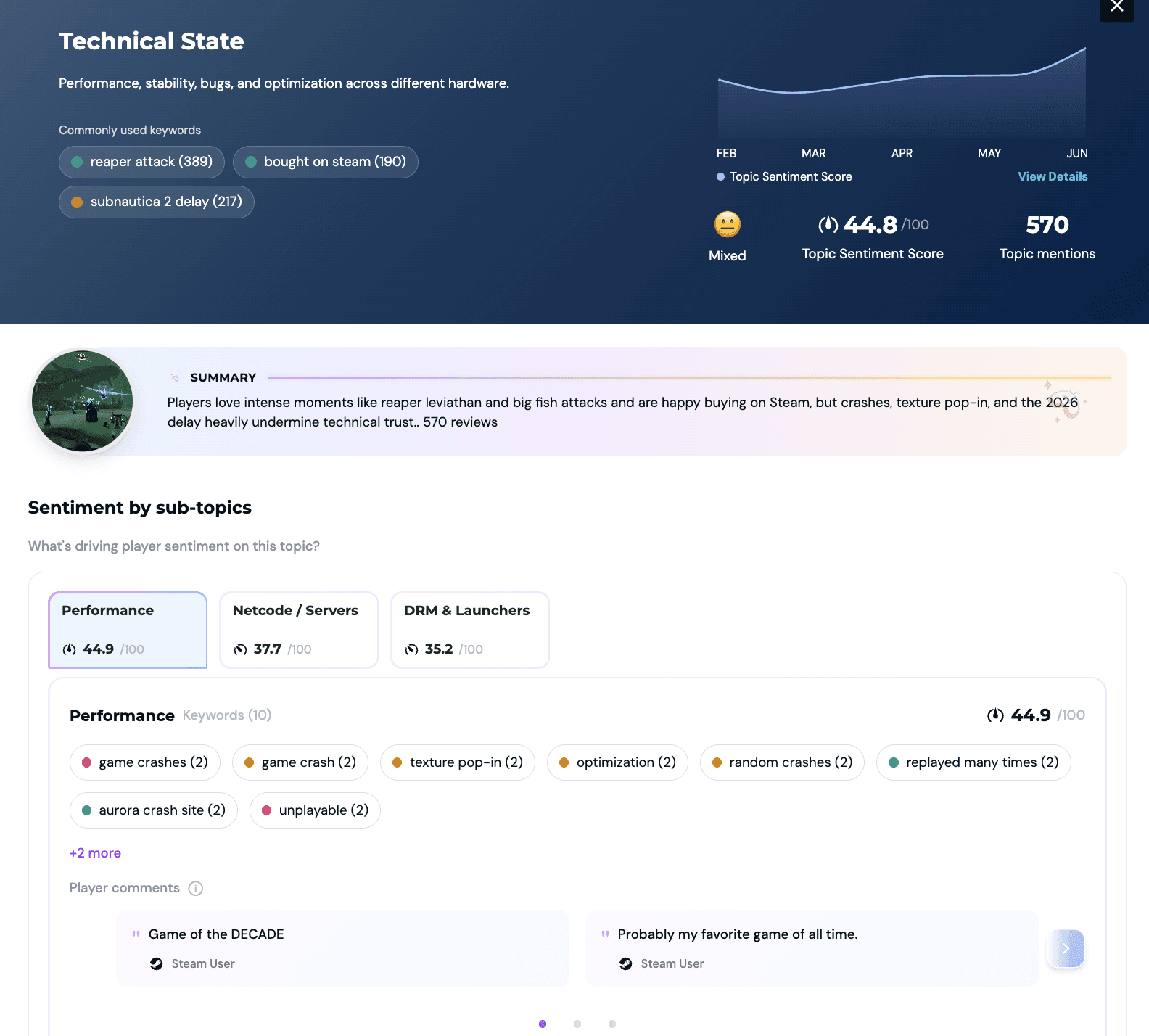
Technical State: 44.8 / 100. Updates broke mods. Builds introduced fatal errors. Repeated deaths with no tutorial scaffolding to help new players understand why or how to recover. In a survival genre, early frustration can become a refund trigger fast.
Live-Ops & Studio Trust: 45.8 / 100. Patch communication was poor. DRM decisions frustrated the community. Legacy version support fell short of expectations. The result is an audience that genuinely loves the game and remains genuinely skeptical of the studio. That's a fragile waterline to launch from.
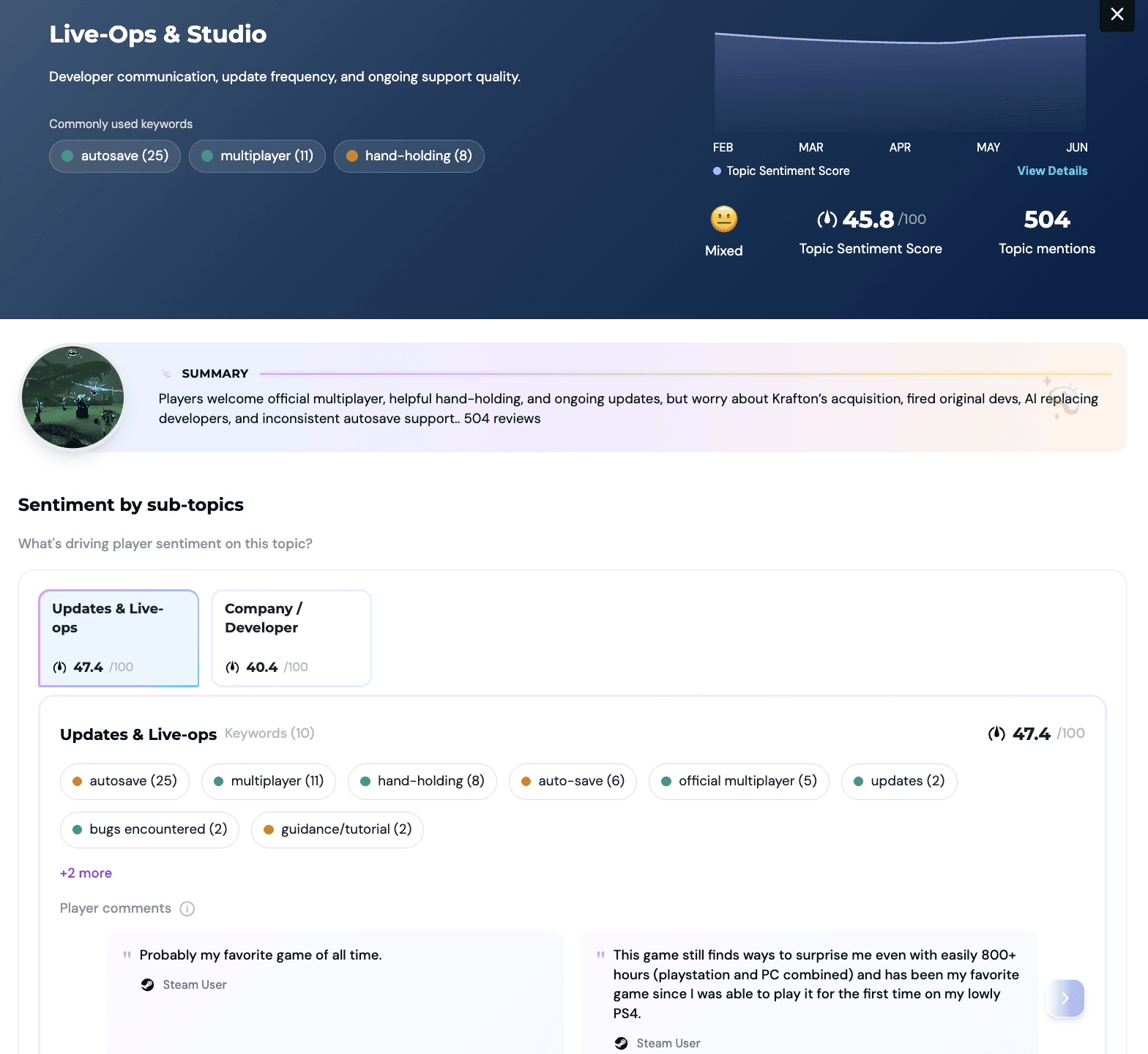
Subnautica 2 will be in Early Access until full release in Q2 2028. That means it will be patched, updated, and iterated on constantly for roughly two years. The patterns that sank these scores in the original are exactly the patterns an extended Early Access cycle amplifies. Getting ahead of them isn't just good practice. For this franchise, it's essential.
What 8 Years of Player Data Tells Us
The original built one of the most loyal audiences in survival gaming by doing a handful of things exceptionally well and refusing to compromise on any of them. The mystery. The atmosphere. The trust implicit in a clean, one-time business model. The feeling that the ocean was genuinely endless.
The sequel has 14 million people waiting before it's even playable. That's an extraordinary position and a lot to live up to.
The formula for honouring it is visible in eight years of data. Protect the mystery. Earn trust on monetisation before players have a reason to doubt it. Don't let the patch cycle become the headline. And whatever changes in the move to co-op and GaaS, don't make the ocean feel smaller.
Frequently Asked Questions
When does Subnautica 2 Early Access start? Subnautica 2 enters Early Access on May 14, 2026. The full release is expected in Q2 2028.
Is Subnautica 2 multiplayer? Yes. Subnautica 2 supports co-op for up to four players, a first for the franchise. It also retains a single-player mode.
What is Subnautica 2's business model? Subnautica 2 is a Games as a Service (GaaS) title. It is available to buy directly and is included in subscription services. The full monetisation structure has not yet been detailed publicly.
How did the original Subnautica perform? According to Lumos data, Subnautica has generated approximately $214.8 million in revenue, accumulated 9.4 million wishlists, and holds a player sentiment score of 83 out of 100 across 4,600 reviews.
Lumos tracks player sentiment, demand signals, and game positioning in real time across 75,000+ titles. Want to run your own game through a breakdown like this?
Try Lumos free
Harish Alagappa
Senior Content Writer
@Gameopedia
Senior Content Strategist. Played an irresponsible amount of Left 4 Dead 2 in college. Now I spend far too much time on Settlers of Catan. Favorite games? Ghost of Tsushima and Crush, an obscure PSP title that deserved better. I believe video games are the defining artform of our time. Why? Stick around and find out.